If you've had a physio put a needle into your shoulder, or an acupuncturist put one into your neck, you've probably wondered whether it was the same treatment. Some people assume it is. Others have been told dry needling is something completely different. Neither answer is quite right.
The easiest way to explain it: acupuncture is the Asian one, and dry needling is the Wasian one. They use a similar needle, and in a stiff neck or a tight trapezius they may end up in similar places. But one was raised on East Asian medical theory, and the other grew up in Western clinics, reasoning from anatomy and neuroscience. What differs is the question being asked before the needle goes in.
Two Sides of the Family
The Asian side. Acupuncture has been practised in East Asia for more than two thousand years. The Huangdi Neijing, compiled around that time, set out the channels, the points and the needling methods that later practitioners built on. Its framework was never limited to pain. It's built around reading a pattern across the whole person and choosing points to suit it.
The Western side. Dry needling has a much shorter history, and it started with an injection. In the 1940s, the American physician Janet Travel described tender, irritable spots in muscle that she called trigger points, and treated them by injecting local anaesthetic and other substances. The Australian physician David Legge, who has traced the technique's history, found published reports from 1941 and 1947 of needling tender points with nothing injected at all. In 1979, the Czech physician Karel Lewit compared the injection techniques and concluded that what they had in common was the needle, not the anaesthetic. He described it as the needle effect. From there, dry needling developed its own models and its own training.
Where They Meet
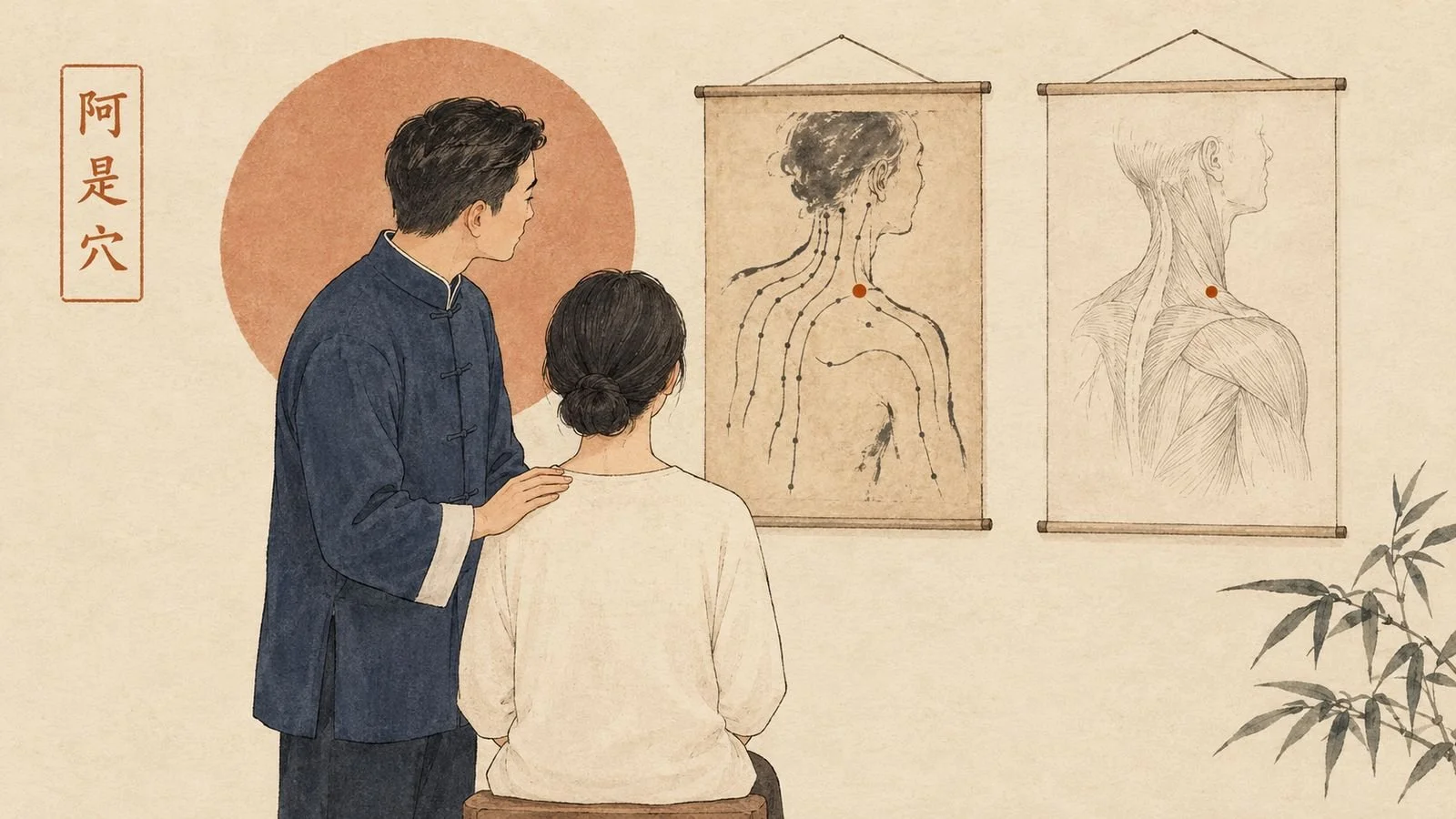
The overlap is older than either profession usually admits. Chinese physicians noticed long ago that some of the most useful places to needle weren't fixed points at all, but wherever the patient was tender. In the Tang dynasty, the physician Sun Simiao gave these a name: 阿是穴, Ah shi points. The name translates as "ah yes", the exclamation a patient makes when the right spot is pressed.
In 1977, researchers at McGill University compared maps of trigger points with maps of acupuncture points for pain and reported a 71% correspondence. That figure has been disputed since, and the argument isn't settled. But a 2022 review from Kyung Hee University in Seoul concluded that trigger points relate most closely to Ah shi points, describing them as the form of Ah shi point found in muscle. For muscular pain, the authors considered the two indistinguishable.
Even the response at the needle has a parallel: a local twitch in trigger point needling, and de qi, the deep ache or heaviness, in acupuncture.
How much of that family resemblance is heritage, and how much is two traditions finding the same spots independently, is still argued.
How They Differ
What the needle is aimed at. Dry needling is aimed at a specific, identifiable target: a trigger point in a taut band of muscle, found by palpation, along with the surrounding muscle and connective tissue. The aim is to reduce the irritability of that tissue so the area can move and load better.
What the needle is part of. Acupuncture starts from the four diagnostic methods and the eight principles. It asks why the problem is there as well as where, and chooses points accordingly. A stiff neck may be needled at its tender spots, which is Ah shi needling, and also at points elsewhere on the body chosen for the wider pattern. Classical acupuncture points are often selected for reasons that go beyond the spot being needled: a point on the forearm, for example, may be chosen when the presenting problem is digestive. Tenderness is one way of finding a point in acupuncture. It isn't the requirement it is in trigger point needling.
Put simply, dry needling is aimed at the tissue. Acupuncture is aimed at the pattern, which can include that tissue.
Family, Not Rivals
Whatever the exact family tree, both exist because two traditions, working in different words, kept returning to the same idea: that needling tender tissue is worth doing. The difference worth knowing is what the practitioner is reasoning from, because that decides what they look for, what they choose to needle, and what they're aiming to change.
If you're seeing a physio and an acupuncturist, tell each of them about the other. If you're weighing up the two, or you've had one and want to understand how the other would differ, get in touch via the contact form.
References
Birch, S. (2003). Trigger point–acupuncture point correlations revisited. Journal of Alternative and Complementary Medicine, 9, 91–103. https://doi.org/10.1089/107555303321222973
Lee, S., Lee, I.-S., & Chae, Y. (2022). Similarities between Ashi acupoints and myofascial trigger points: Exploring the relationship between body surface treatment points. Frontiers in Neuroscience, 16, Article 947884. https://doi.org/10.3389/fnins.2022.947884
Legge, D. (2014). A history of dry needling. Journal of Musculoskeletal Pain, 22(3), 301–307. https://doi.org/10.3109/10582452.2014.883041
Lewit, K. (1979). The needle effect in the relief of myofascial pain. Pain, 6(1), 83–90. https://doi.org/10.1016/0304-3959(79)90142-8
Melzack, R., Stillwell, D. M., & Fox, E. J. (1977). Trigger points and acupuncture points for pain: Correlations and implications. Pain, 3(1), 3–23. https://doi.org/10.1016/0304-3959(77)90032-X
Want to talk through whether acupuncture suits you? Book an appointment.
